Thursday, February 11, 2016

pGLO Transformation Experiment


Introduction
During the week of February 1st, Shreyan, Vikram, Vinay and I returned to the lab to perform an experiment involving transformation and protein production. Transformation is the process by which organisms take up new DNA, in this case in the form of plasmids, that change a trait or cause the production of new proteins. Plasmids are a form of DNA that are taken up by bacteria and then used to produce proteins in the cell. This is a useful biological process because it can help the bacteria to produce new proteins and integrate new genetic diversity into a population.


Genetic transformation is an extremely useful process for science, being used by pharmaceutical companies to produce large quantities of antibiotics or drugs, by agricultural companies to introduce new beneficial traits to organisms to help them grow, and even by doctors to cure sick people. For our experiment, the group is tasked with transforming a harmless strain of E. coli bacteria with a plasmid DNA that we are given called pGLO. The DNA contains genes for Green Fluorescent Protein (GFP), obtained from jellyfish, as well as a gene for resistance to the antibiotic ampicillin. We are hoping that the introduction of this plasmid will cause the bacteria to produce GFP as well as be resistant to ampicillin so that we can isolate the bacteria that have taken up the plasmid. Below is a diagram for the pGLO plasmid.


GFP, as the name implies, is a fluorescent protein produced by jellyfish to glow. However, the pGLO plasmid has been specially engineered to use a gene regulation system that controls the expression of GFP in cells with the plasmid. The gene that codes for GFP can be activated in the cell, but only when the cell is in the prescence of the sugar arabinose. Therefore, the cells will be ampicillin resistant, so will grow on agar plates with ampicillin, but will not glow unless activated by a plate with arabinose.

Knowing all of this from our discussions in class and reading, the lab group got to work.

Materials

  • E. Coli Starter Plate
  • Poured Agar Plates
    • 1 with only nutrient broth
    • 2 with nutrient broth and ampicillin
    • 1 with nutrient broth, ampicillin and arabinose
  • Transformation Solution
  • Nutrient Broth
  • Inoculation Loops
  • Pipets
  • Foam Microtube Holder
  • Foam Cup Full of Ice
  • 42 degree Celsius Water Bath
  • 37 degree Incubator
Procedure
The first thing that the entire lab group did was put on safety equipment such as goggles and aprons so that we do not accidentally hurt ourselves with the E. coli we were experimenting with (Note: this step may or may not have been forgotten). Next, we labeled our microtubes, one as +pGLO and the other as -pGLO. Using a pipet, we then transferred 250 micoliters of transformation solution into each tube. Placing the tubes in our foam cup of ice, Shreyan and I used the inoculation loops to grab a single colony of bacteria from the starter plate and place it into each microtube, swirling the solution to make sure all bacteria were taken off the loops. 

Using a micropipet, the lab group removed 10 microliters of pGLO DNA and put it into the microtube labeled +pGLO. We made sure not to ass the plasmid DNA to the other microtube because it would ruin our experiment. Following this, the group iced the microtubes for 10 minutes.

While the tubes were icing, we labeled the 4 agar plates that we had, one as -pGLO LB (no plasmid, only nutrient broth), one -pGLO LB/amp (no plasmid, nutrient broth and ampicillin), one +pGLO LB/amp (plasmid with nutrient broth and ampicillin), and one +pGLO LB/amp/ara (plasmid, nutrient broth, ampicillin, and arabinose). 

After 10 minutes of icing, we took the microtubes out of the ice and put them into the 42 degree hot water bath for 50 seconds. This helps us perform what is called a heat shock. To get the bacteria to take up the new plasmid DNA, the bacteria is iced and shrunk, then the heat of the heat bath causes it to rapidly expand, sucking up fluid from the transformation solution that also just happens to contain new DNA for the bacteria. Thus, after the heat shock, the plasmids are inside the cells.

To keep the plasmids inside the cell and stop the cells from exchanging fluid with the surrounding solution, we put the microtubes back on ice to shrink the cells back down again. We iced the cells for 2 minutes, and then added 250 microliters of nutrient broth to the microtube solutions to help the bacteria survive. We then flicked the containers to mix the solution. 

Using a new pipet for each time, the lab group put some of the microtube solution on each plate. 100 microliters of the +pGLO solution was added to the plates marked +pGLO, and then 100 microliters of the -pGLO solution was added to the plates marked -pGLO. The group then used inoculation loops, a new one for each plate, to spread the solution around the agar and allow the bacteria to access the nutrients in the agar. 


Once this was finished, the group stacked our plates up, taped them together, and placed them all in the 37 degree incubator for a day so that the bacteria colonies could grow. Then the next day we checked our plates to see if our transformation was successful. 

Data/Observations
When we checked our agar plates, the lab group discovered that our experiment was not as successful as we had hoped. 

For our control plates, the results were as we had predicted. Unfortunately, no one in the group took pictures of our experiment or our agar plates, so I will use diagrams filled out in class to show the growth on each of the plates.


On the -pGLO LB plate, there was carpet growth of bacteria because the bacteria's growth was not impeded, as seen in the diagram above.


On the -pGLO LB/amp plate, there was no growth of bacteria, presumably because all of the bacteria were killed by the ampicillin. This is shown on the diagram above.
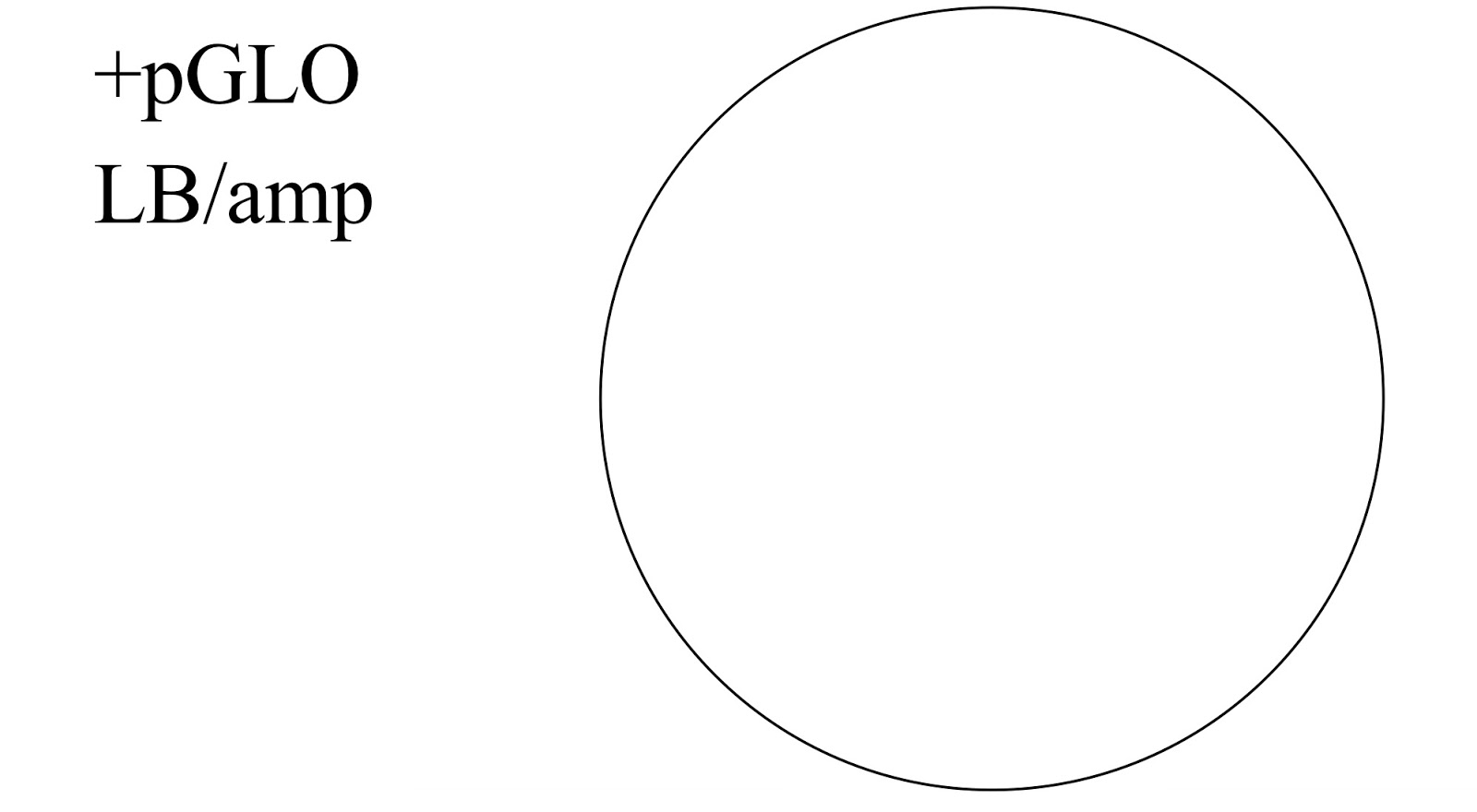

On the transformation plates, our results were extremely disappointing. For the +pGLO LB/amp plate, there was no growth at all. This can be seen in the diagram above.


On the +pGLO LB/amp/ara plate, there was little growth. Only one colony of bacteria grew on this plate, and when placed under UV light, this colony glowed. The growth on this plate can be seen in the diagram above.

In comparison to other groups' bacterial growth on their plates, our group's plates had extremely low growth. For example, here is a photo of the agar plates from Joe Ballard's group, shown under a UV light so we can see the group's GFP protein in the bacteria glow.


As you can see, there is considerable growth on the bottom plate, which contains nutrient broth, ampicillin and arabinose as seen by the glowing protein.

Conclusion
In conclusion, though our transformation was not completely successful, I believe that our experiment was a success. We were in fact able to transform bacteria, even tho in this case we only transformed a single bacterium. Whereas some people may call that unlucky, the lab group calls it lucky that we were able to only get a single bacterium to transform. In fact, one could argue that our group was more precise with our transforming, seeing as we were able to precisely change the DNA of one bacterium. 

Using our knowledge of mathematics and different values from the experiment, the group was able to calculate the transformation efficiency of our experiment. Using the number of cells growing on the agar plate divided by the amount of DNA spread on that plate, we determined that our group's transformation efficiency was 6.373 transformants/microgram of DNA used. When the entire class collected data of their own transformation efficencies, we found out that our efficiency is not a good efficiency. The other groups got inefficiencies of anywhere from 700 transformants/microgram to 10,000 transformants/microgram! 

Even though the group did the procedure exactly as it is listed in the manual, I think there are a few likely possibilities of where we went wrong. I think when rubbing the bacteria onto the agar plates, perhaps the group was too gentle and did not press down hard enough because we did not want to split the agar. Another time that we could have gone wrong is when we transferred the microtubes from the hot water bath back into the ice cup. Perhaps our tubes were not immersed in the ice far enough and therefore the bacteria did not shrink in time to keep the plasmids inside. Both of these errors are due to experimenter mishaps, which is very disappointing considering how hard we worked on transforming the bacteria. Moving forward, I believe that if had another shot at transformations and didn't make any mistakes as we had for this experiment, we could have an extremely high transformation efficiency. 

Tuesday, January 26, 2016

DNA Replication: The Movie Report

Here is a link to the DNA Replication video that the group made:

https://www.youtube.com/watch?v=4fhPwZePSOU

Though we had read through the DNA Replication chapter in our textbook and even sat through multiple lectures with Mr. Wong about DNA Replication in both Eukaryotes and Prokaryotes, each member of the group learned more about DNA Replication through producing this video.

I think the most difficult concept to grasp from DNA Replication was the concept of the lagging strand. When I first came to class, I knew that DNA on the lagging strand was completed in fragments, but it didn't really understand why and how DNA Polymerase did this. Being forced to model the motion of the protein and track its path delivering and connecting nucleotides to the new strand of DNA after finding an RNA primer, I realized the how the protein's one way system of elongation worked. Because the strands are antiparallel and DNA Polymerase only works from the 5' to the 3' direction, the lagging strand must be broken into fragments to keep up with the splitting of the replication fork by helicase.

Furthermore, I had always wondered why the DNA strand couldn't just be split into two large molecules, the absolute 5' end of each molecule is primed, and then replication occurs, but only in one direction. Then, when I started putting together the fake DNA strands for the video and had to keep track of all the nucleotides and make sure the strand didn't double over or kink, I realized how impossible that split would be floating around in a cell's nucleus. The best way to counteract the kinking and twisting of the molecule would be to keep it together until the last possible moment, then split it and replicate the DNA. This is how cells do it, using replication bubbles instead of breaking up the entire strand of DNA.

I think my group made plenty of mistakes when creating our video, such as not using RNA and DNA Polymerase I to show how RNA primers on the new DNA molecule are removed, but I think that through this process, the entire group now has a mental representation of what DNA Replication must look like and has a concrete experience moving the proteins around. This will help us immensely when thinking critically about DNA problems, and being able to model the process in our minds will far outweigh other students' ability to memorize names and processes.

Friday, January 8, 2016

Your Inner Fish Blog Entry

I was fascinated by the entire Inner Fish program because discovering the links between our distant ancestor species and uncovering more about the human evolutionary history is extremely interesting and gives us a greater understanding of where we came from and why our bodies are shaped the way they are. I think at the beginning of the program I expected an organism like Tiktaalik to be the transitional animal between fish and amphibians: one with strong and flat arms used to kind of shuffle around on land, possessing both gills and lungs, scaled, possessing fins and a fishlike tail, and one that spends most of its time in the water but can also go for periods above water exploring land. I think Tiktaalik is a lot like some modern fish, pikes I believe, that are actually able to do the same thing and climb onto shore and walk around land for a short time. These fish possess both lungs and gills, but their lungs have a very small capacity so therefore they must return to their native water to survive. Though I will never see if this is true or not because evolution takes so long, I think that these types of pike fish could possibly open up another branch of animal evolution.

I think that a transitional animal between reptiles and mammals would look a lot like a crocodile or a lizard with fur. I think that the animal would be partially scaly, but large portions of its body would be covered in fur as most mammals are. The animal would walk on four legs and have short, stubby legs that it must swing from side to side to move forward. Also it would probably be a land based creature, because most mammals do live on land and not in the ocean like dolphins and whales. I believe that the transitional animal would have hardshell eggs, but incubate them internally and then give birth to live young because this is a combination between reptile and mammalian forms of birth. This creature would also produce milk as all mammals do to feed their young. As for the features of the animal, I think it doesn't have a fully articulated neck, but more like a neck that only looks up and down like a crocodile, and have binocular eyes like most mammals, not eyes on each side of its head as some reptiles like the chameleon has. Finally, the animal would have been warm blooded, which is necessary for the internal incubation of eggs as mentioned above. If the animal was cold blooded, the dramatic shifts in temperature could hurt the offspring. Below is a picture of what I think the transitional animal between reptiles and mammals looked like.


The brown areas of the animal represent the fur-covered areas, while the green parts are covered in scales. The animal is very squat and short, and probably moves around in a shuffling run.

Tuesday, December 8, 2015

Meiosis Movie Blog Entry

When is the DNA replicated during meiosis?

As in mitosis, DNA is replicated during the S phase of the cell, between the G1 and the G2 phases of the cell. The only difference between mitosis and meiosis is that the cell that is dividing for mitosis is a regular somatic cell, while the cell used for meiosis is a specialized germ cell located in the sexual organs whose sole purpose is to grow and divide into 4 gametes.


Are homologous pairs of chromosomes exact copies of each other?

Homologous pairs of chromosomes are not exact copies of one another because one of the homologs is given to the cell from its father, and the other is from its mother. When DNA is replicated, the entire chromosomes are not replicated, only the sister chromatids from each of the parent's genes. There are many genetic variations between the chromosome belonging to the father and the chromosome belonging to the mother, and this in turn promotes genetic variation.


What is crossing over?

Crossing over is a process by which homologous pairs of chromosome form crossing points, called synapse, and exchange sets of DNA between each other. This means that the father's chromosome could trade its portion of DNA that codes for hair color, for example, with the mother's chromosomes gene for hair color.  The resulting chromosomes are called recombinant chromosomes. This increases genetic variation because then it means that gametes can have random combinations of their parents DNA, not just be forced to have one or the other parents's genetic information.


What physical constraints control crossover frequency?

The physical constraint for crossing over are where the gene is on the chromosome. Because crossing over could lead to huge problems in a gametes DNA if a gene is spliced in half incorrectly and would therefore become defective, crossing over can only happen when two complete genes are switched. Therefore, only certain sections of the chromosome can swith, and if they do switch, the entire gene is moved.


What is meant by independent assortment?

Independent assortment is the process by which homologous chromosome pairs line up along the metaphase plate during meiosis I. When the chromosomes line up, they are not forced to have all of the maternal DNA on one side and all the paternal DNA on the other. Instead, because the homologs assort independently, there is a random mixture of paternal and maternal DNA on each side of the metaphase plate. Thus, in turn, when the homologs separate, a random mixture of DNA is put into each resulting gamete.


What happens if a homologous pair of chromosomes fails to separate, and how might this contribute to genetic disorders such as Down syndrome and cri du chat syndrome?

When a homologous pair of chromosomes fails to separate, the gametes resulting from that meiosis will either have one less or one extra chromosome. Without the correct number of chromosomes, if this gamete becomes a zygote, the child will face genetic disorders such as downs syndrome, which is having an extra chromosome 20, 21, or 22; or cri du chat syndrome, which is the deletion of the 5th chromosome. The child's DNA is messed up, and therefore their mental capabilities and many of their body's structures are abnormal.


How are mitosis and meiosis fundamentally different?

Mitosis and meiosis are fundamentally different in both their purpose and their products. For mitosis, the purpose is just to produce two identical, diploid cells to either increase the size of an organism as in a teenager going through puberty, or replace dead cells such as on a skinned knee after a bicycle accident. Meiosis, on the other hand, produces 4 haploid cells used for sexual reproduction. Each cell produced is different from the rest of the haploid cells produced because of processes that promote genetic diversity like crossing over and independent assortment.


Link to meiosis video:
https://www.youtube.com/watch?v=OZLBftmBsow

Sunday, December 6, 2015

Investigation 7: Part 2

Introduction
Cells, the building blocks of the body, are constantly dying and replacing themselves. Through a process called mitosis, one cell divides itself into two daughter cells that can then grow and divide as well. Though mitosis is the most lively stage of a cell's life cycle, it is also the smallest portion of that cell's life, with large phases of growth and DNA replication occurring alongside mitosis. Pictured below is a diagram representing a typical cell cycle.

The Cell Cycle

As seen above, a cell's life is mostly growth and DNA replication that is punctuated by brief period of mitosis. So, this large time period, called Interphase, is just as important as mitosis, even though mitosis is where the action is at. Returning to the lab, Vikram, Vinay, Shreyan and I were tasked with the seemingly simple mission of counting cells in a growing root tip. In the root tip, because it is growing, there would be many cells performing mitosis and also quite a few in Interphase, as they are all over the organism's body. We had to find out how many cells were undergoing mitosis, and also we counted how many cells were in their Interphase stage.

Unfortunately for us, there isn't an exact indicator on when a cell is undergoing mitosis or not, so we had to use our eyes and make an educated guess on whether or not a certain cell was dividing or not. We also tried to compare the cells we saw under the microscope to diagrams such as the one below, which shows the different stages of mitosis so we could compare the two and determine if the cell in question was dividing or not.


As well as simply counting cells of a regular root tip for our control group, we also had to count cells of a root tip that had been specially treated as an experimental group. We were not told what the chemical was that the cells had been treated with, but we expected an increase in the number of cells undergoing mitosis because we believed that the chemical would mess with the cell cycle, but there was no explanation as to why we believed the rate of mitosis would increase.

Procedure
To begin, the group picked up two microscope slides from Mr. Wong, one regular, unlabeled slide, and a slide that had been treated with the unknown chemical and was labeled "T". Then, using the microscope, we took a picture of a certain part of each slide, and transferred the pictures to our iPads where we expanded the pictures and began labeling whether or not a cell was in mitosis. If the cell was undergoing mitosis, it was labeled "M", if it wasn't, it was labeled "I" for Interphase. After counting all of the cells that we could, we tallied up the number of cells in mitosis and not in mitosis, and then we shared our numbers with the class. The date is below.

Data/Pictures
Here is the table of all of the class's data from groups 1 to 6.


Control
Experimental
Group
Interphase
Mitosis
Interphase
Mitosis
1
131
11
147
22
2
140
9
142
3
3
155
16
272
18
4
368
17
162
23
5
141
5
330
15
6
234
5
269
21

Here is a picture of the cells that we counted for our control group:


Here is the picture of the cells that we counted for our experimental group:


Conclusion
For our conclusion, rather than writing in the regular paragraph form, we were asked to answer the questions associated with our lab in our lab packet, and also some Postlab Review Questions posted on Canvas.

Investigation 7 Part 2

Collect the class data for each group, and calculate the mean and standard deviation for each group. Make a table. These are the observed values for the class.

Table 1

Control
Experimental

Interphase
Mitosis
Interphase
Mitosis
Mean
195
11
220
17
Standard Deviation
93
5.2
80
7.5

Use the data from Table 1 to calculate the totals using formulas found in Table 2

Table 2

Interphase
Mitosis
Total
Control
A
B
A + B
Treated
C
D
C + D
Total
A + C
B + D
A + B + C + D = N

Table 2 Completed

Interphase
Mitosis
Total
Control
195
11
206
Treated
220
17
237
Total
415
28
443

Use the totals from Table 2 to calculate the expected values (e) using the formulas from Table 3.

Table 3

Interphase
Mitosis
Control
[(A + B)(A + C)]/N
[(A + B)(B + D)]/N
Treated
[(C + D)(A + C)]/N
[(C + D)(B + D)]/N
'
Table 3 Completed

Interphase
Mitosis
Control
192.98
13.02
Treated
222.02
14.98

Enter the observed Values from Table 2 and the expected values from Table 3 for each group into Table 4. Calculate the chi-square value for the data by adding together the numbers in the right column.

Table 4
Group
Observed (o)
Expected (e)
(o - e)
(o - e)2
(o – e)2/e
Control I
195
192.98
2.02
4.0804
0.021
Control M
11
13.02
-2.02
4.0804
0.167
Treated I
220
222.02
-2.02
4.0804
0.018
Treated M
17
14.98
2.02
4.0804
0.267
Chi-Square value = 0.473

Because there was only one degree of freedom, the critical value for a p value of 0.05 is 3.84. The Chi-Square value is less than the critical value, the null hypothesis is not rejected and therefore the experiment cannot be definitively concluded to have not happened due to random chance.


Postlab Review
What was the importance of collecting class data?

The importance of collecting class data was to create a large enough sample size to calculate a valid chi-square value. If the sample size used for this value was extremely small, as it would have been had the values used in calculations had only come from one lab group, then the chi-square value would be less significant. This is because the single lab group could have been a fluke and then the rest of the class could have gotten completely different sets of data.

Was there a significant difference between the groups?

There was not a significant difference between the group. Because there was only one degree of freedom, the critical value for a p value of 0.05 is 3.84. The Chi-Square value is less than the critical value, the null hypothesis is not rejected and therefore the experiment cannot be definitively concluded to have not happened due to random chance.

Did the fungal pathogen lectin increase the number of root tip cells in mitosis?

If this slides in this experiment were treated with lectin, I think we might have seen a change in the number of root tip cells in mitosis, but Mr. Wong revealed to us that the "treated" slides were not in fact treated with anything. Rather, Mr. Wong just labeled some control slides "T" and let our minds do the rest. During the experiment, as groups began reading off data, Mr. Wong actually told some groups, including mine, to recount their cells because their data was wildly off in that it showed a large increases in the number of cells in mitosis in the treated group as compared to the control. This is actually a phenomenon studied in psychology called observer bias, or the tendency of researchers to see data in a light that is favorable to their hypotheses. This is a common human error that the entire class made for this experiment.

What other experiments should you perform to verify your findings?

Other experiments that could be performed would be to look at more root tip cells or cells of a different plant and then counting cells and seeing if the chi-square value is different for those. Or we could actually use slides treated with something to determine the effects an environment can play on cells.

Does an increased number of cells in mitosis mean that these cells are dividing faster than the cells in the roots with a lower number of cells in mitosis?

An increased number of cells in mitosis does in fact mean that the cells are dividing at a faster rate than in roots with lower numbers of dividing cells because all cells are on their own specific timers of when to divide and when to not divide. The cells are not synced up at all, because that would be catastrophic if all of our cells divided at one time. Therefore, when the rate of all cells dividing speeds up, more cells are brought to mitosis around the same time, so during a snapshot look into the lives of the cells, as in the treated root tip slides, more cells would be undergoing mitosis than in a regular root tip.

What other way could you determine how fast the rate of mitosis is occurring in root tips?

Another way to measure the rate of mitosis in root tips is to measure the growth of the root tip as a whole. As cells divide and grow, more space is taken up and the tip of the root is pushed farther and farther along. So, as the tip expands, there are more cells performing mitosis. 

Monday, November 23, 2015

Mitosis: The Movie Blog Entry


  • If a cell contains a set of duplicated chromosomes, does it contain any more genetic information than the cell before the chromosomes were duplicated?

I believe that the cell does not contain any more genetic information after DNA has been duplicated than the cell prior to the duplication because there is no more content to the DNA, only two exact copies of the same coding for genes. This can be compared to a class reading a paper. Though there will be many copies of the paper, the words on the page and information stored within that page is the exact same for everyone and does not increase or decrease in value depending on how many copies of it there are.


  • What is the significance of the fact that chromosomes condense before they are moved?
The fact that chromosomes condense before they move is significant because it is the condensing of the chromosomes that makes the splitting of the sister chromatids so much easier. If the strands were lined up in the middle of the cell during metaphase as the long strings that they normally exist in, and then tried to condense, there would be nothing for the spindle fibers to grab onto and it would also impede the fibers' process.

  • How are the chromosome copies, called sister chromatids, separated from each other?
Because the chromatids are linked by the centromere and brought to the middle of the cell by the spindle fibers, they are held tightly in place in the metaphase plate. When it is time to split, the enzyme separatase is activated, cutting the centromere bonds of the two chromatids and immediately enzymes within range of the spindle fibers on the chromosomes began to eat the fibers, thus drawing each separate chromatids closer to its respective ends.

  • What would happen if the sister chromatids fail to separate?
IF the sister chromatids failed to separate, then one cell would have a chromosome more than normal, and the other would have one less than normal. Because they store the genetic material for life on these chromosomes, cells cannot function well without even a single chromosome. They will produce incorrect proteins and could present horrible defects for the entire organism, especially if the sex cell that created the organism had one more or one less chromosome. An example of this would be down syndrome in humans. For people with down syndrome, when their parents sex cells came together, one had an extra copy of chromosome 21. If one of the first 15 or so chromosomes in the human genome have an extra copy or are missing one of the air, the cell will die because their cells just cannot function with that inherent problem.

  • What events could promote genetic variation during mitosis?
There are not many events that could promote genetic variation directly during mitosis because the cell has already replicated the DNA and encoded mutants, which is the primary cause for genetic variation. But during mitosis, the splitting and replication of mutant cells promotes genetic variation because then the mutation spreads through the body or to other tissues and if it it compatible and advantageous, could be kept in the organism.

  • What problems could occur with a loss of cell cycle control?
The biggest problem that occurs with a loss of cell cycle control is cancer. With cancer, the cells never stop dividing and spreading, causing major harm to the host and using up a lot of the bodies resources. But even if the process went the other way and one's body couldn't get its cells to replicated to replace tissues lost due to damage or the cells coming to the end of their life span, then the body would die because eventually all the cells in the body would perish and there would be nothing to replace them with.


Link to my group's mitosis movie:

https://www.youtube.com/watch?v=iRTmGbMQ4A0&feature=youtu.be

Thursday, November 19, 2015

Investigation 5: Photosynthesis

Introduction
How does the oxygen that we breathe enter the air? And how does the carbon dioxide that we exhale get taken out of the air so that we do not suffocate on it? The answer to both of these questions is photosynthesis, a chemical process for creating energy and sugars within a plant. Photosynthesis takes place in the leaves of a plant, and within the leaves' cells, in the chloroplast. In the chloroplast are specialized molecules called chlorophyll that absorb light and this absorption excites an electron that then goes through a complex series of reactions to form NADPH, an electron carrier, and ATP, an energy source for the cell.

An Overview of Photosynthesis


However, the chlorophyll only absorb a certain frequency of light, and it only absorbs light from the visible light spectrum, so colored light. The chlorophyll do not even absorb the entire spectrum of visible light, usually only absorbing one or two colors of light between a certain wavelength very well, and reflecting the rest. The plant has developed two different types of chlorophyll to account for that, chlorophyll a and chlorophyll b, as well  separate compound called carotenoids.

Absorption Rates of Chlorophyll and Carotenoids


On Friday, November 6th, Vikram, Vinay, Shreyan and I entered the lab again to learn more about photosynthesis. We decided to test the rate of the reactions of photosynthesis under different colored light so that we could see to what affect the absorption of light by the chlorophyll and carotenoids affected the overall reaction. We hypothesized that the rate of reaction would slow when under green light because the chlorophyll and the carotenoids have very low absorption rates in green light as seen above. Also, leaves reflect green light, as seen in their green color.

Our first problem is finding a method by which we could measure the rate of photosynthesis in a plant. Because it is a minuscule process, we couldn't observe it directly through a microscope, but instead would have to find evidence that it is occurring. Here is the chemical equation for photosynthesis:


To find the rate of photosynthesis, we could track the production of one of the products above, or the diminishing of one of the products. Carbon dioxide is a possibility, but would be difficult to measure in an open environment. Water is likewise hard to track, as well as glucose, because we cannot directly see the number of molecules. This leaves us with oxygen, which is also difficult to track individual molecules. Instead of doing that, however, we decided to use the buoyant properties of oxygen in water to measure the rate of reaction. Because as oxygen is produced in leaves during photosynthesis it is kept in the center of the leaf before being expelled through the stomata, the leave actually becomes quite airy. So we could put the leaves in water and watch them float to the top. But to photosynthesize, there must be a source of light, a source of H2O and a source of CO2. If the leaves were submerged, they would not have access to CO2 and would therefore not photosynthesize. Therefore we submerged the leaves in a bicarbonate solution, which would put CO2 into the water for the plant to grab and use for photosynthesis.

The problem with this plan was that the leaves already contained oxygen, so they would float on their own. The only way around this was to evacuate the oxygen from the leave by sucking it out using pressure. At a lower pressure, the oxygen will expand and fill the space, leaving the leaf for the most part and entering the surrounding space around the leaf. Doing this evacuation on a leaf would require larger syringes and tools than we have available so instead we decided to cut the leaves into small dots so they'd fit in the syringe and it would even make the submersion in water easier because then we would not have to find a large tank to submerge full leaves in.

As you can see, a leaf consists of cells but also quite a bit of empty space to hold gases like CO2 and O2


For our experimental variable, which is the color of the light that the plant would be exposed to, we figured we could change this using different colored cellophane. The cellophane would absorb all of the light that wasn't its own color, and let that color through to hit the leaf-dots below. For our controls we performed an experiment with clear cellophane that would supposedly let all light through, but we also did an experiment without cellophane to see if the clear stuff did in fact absorb even a tiny amount of light.

Because of the time consuming nature of the reaction and its effects on the leaf-dots, and the limitations of our equipment, the lab group joined forces with a lab group consisting of Christos, Jorgos and Callen. One group would do three cups with different variables, and the other would do three different cups with different variables, and the data would be shared among us all. Vikram, Vinay, Shreyan and I did the experiments with blue cellophane, yellow cellophane and no cellophane at all.

With this plan of attack, we began our experiment.

Procedure
First, the lab group went outside to pick two fresh ivy leaves to perform our experiment with. We needed to get still living leaves so that they would perform photosynthesis. Next, using the apparatus shown below, I hole-punched 30 dots of leaf out of the leaves and split them into 3 piles. These would be later used for our experiment.


Next, the group created 300mL of a 0.2% bicarbonate solution to submerge the leaves in. Then we evenly separated the solution into three cups and cut three pieces of cellophane for the cups; one blue, one yellow and one clear. Then a drop of dilute soap was added to each cup. The soap acts as a wetting agent to force the leaf dots to allow water from the solution into the cell and sink. This also helps the leaves get their source of CO2 from the solution.


Next we evacuated the leaf dots of all air. To do this, we put 10 dots at a time into a syringe with a stopper and sucked up 10 mL of the bicarbonate solution into the syringe. Then we upended the syringe and squeezed the stopper so all of the air in the solution was evacuated. Once this was done, I put my finger on the opening of the syringe and pulled back on the stopper, effectively creating a vacuum in the syringe chamber, for 10 seconds. I then released the stopper and poured out the 10 leaf dots into one of the cups. This was repeated for each separate group of leaf dots.

Once the first set of leaf dots was evacuated, we immediately started our experiment so as to avoid sunlight causing the leaves to begin their photosynthesis while we evacuated the rest of the dots. This would've caused a skew in our data, but luckily we removed that confounding variable. The experiment consisted of a piece of colored (or clear) cellophane covering the cup and the cup was then placed under a lamp. The light from the lamp then caused the cells in the leaf dots to photosynthesize. We also started a separate timer for each experiment group so we could accurately keep time.

After all of the dots were in their cups and the cups were placed under the lamp, we observed the number of leaf dots that had risen completely to the top and recorded this data. After all the dots had risen, or 30 minutes, the experiment was stopped, and the dots were poured out.

Data/Tables
Here are the results of trials with the blue, yellow and lack of cellophane.

Time (min)
# of dots risen (clear)
# of dots risen (blue)
# of dots risen (yellow)
1
0
0
0
2
0
0
0
3
0
0
0
4
0
0
0
5
0
0
0
6
0
0
0
7
0
0
0
8
0
0
0
9
0
0
0
10
0
0
0
11
0
0
0
12
0
0
0
13
0
0
0
14
0
0
1
15
0
0
2
16
0
0
4
17
0
0
5
18
2
0
5
19
3
0
7
20
6
0
7
21
8
0
7
22
10
0
7
23
-
0
8
24
-
0
8
25
-
0
9
26
-
1
9
27
-
1
9
28
-
1
10
29
-
2
-
30
-
3
-


And a picture of the experiment in action:


Here is the data received from our lab group partners Jorgos, Christos and Callen, who experimented with green cellophane and a control cup of no cellophane.

Time (min)
# of dots risen (no cellophane)
# of dots risen (green)
1
0
0
2
0
0
3
0
0
4
0
0
5
0
0
6
0
0
7
0
0
8
0
0
9
0
0
10
0
0
11
0
0
12
0
0
13
0
0
14
0
0
15
0
0
16
0
0
17
1
0
18
1
0
19
1
0
20
1
0
21
1
0
22
1
0
23
1
0
24
1
0
25
1
0
26
1
0
27
2
0
28
2
0
29
2
0
30
2
0


Here is a graph of the results of both experiments combined:


Conclusion
Looking at the results of our experiment, I'd say that the lab was a relative success. As expected, when the plant was exposed to all types of light while under the clear cellophane, the rate of photosynthesis was fastest because all 10 dots floated to the top in the shortest amount of time when compared to single-color lights. However, a confusing piece of data is the extremely low number of dots, only 2, that floated to the top without any cellophane in Christos, Jorgos and Callen's experiment. Plants do not need cellophane to photosynthesize because cellophane is not found in nature, so that cannot be the reason why the dots didn't rise. I believe that there could have been some error with the evacuation of the cells because if one evacuates the cell too hard or for too long, the cell's chloroplasts will die and it will not photosynthesize. This could have happened for our compatriots. Other points of data, however, are quite normal. We did not expect the dots to photosynthesize much while under green light because leaves do not absorb much green light, if any. I was somewhat surprised at our data for blue light because I had thought that the rate of absorption hit a peak for chlorophyll when under blue light, but only 3 dots rose to the top of the water in that group. The results of the yellow group are also predictable because some of the peak absorption of leaves happens near red light, which is right next to yellow light on the visual light spectrum. Therefore, plants should also be able to absorb a lot of yellow light.

Due to the evacuation error mentioned above, as well as other fixes for the lab, the experiment could be improved in a variety of ways. First of all, all of the leaf dots should be evacuated together so that they all have the same level of evacuation when starting the experiment. This would also make sure that different groups using different syringes and applying different pressures wouldn't skew the data as it did for Jorgos' group. Another way in which the lab could be improved is, if the lab group had a long time to spend doing the experiment, we could use the same lamp and place the cup in the same spot each time so that we can ensure that the dots in the cup are receiving the same amount of light from the lamp and that they aren't missing out on light due to position.

I believe that this can be considered a success because we got data that we expected to get, our hypothesis was proved true, but also because we made mistakes. These mistakes helped us to learn ways in which we could improve our lab for next time as well as how to look out for confounding variables in coming labs we have not performed yet.